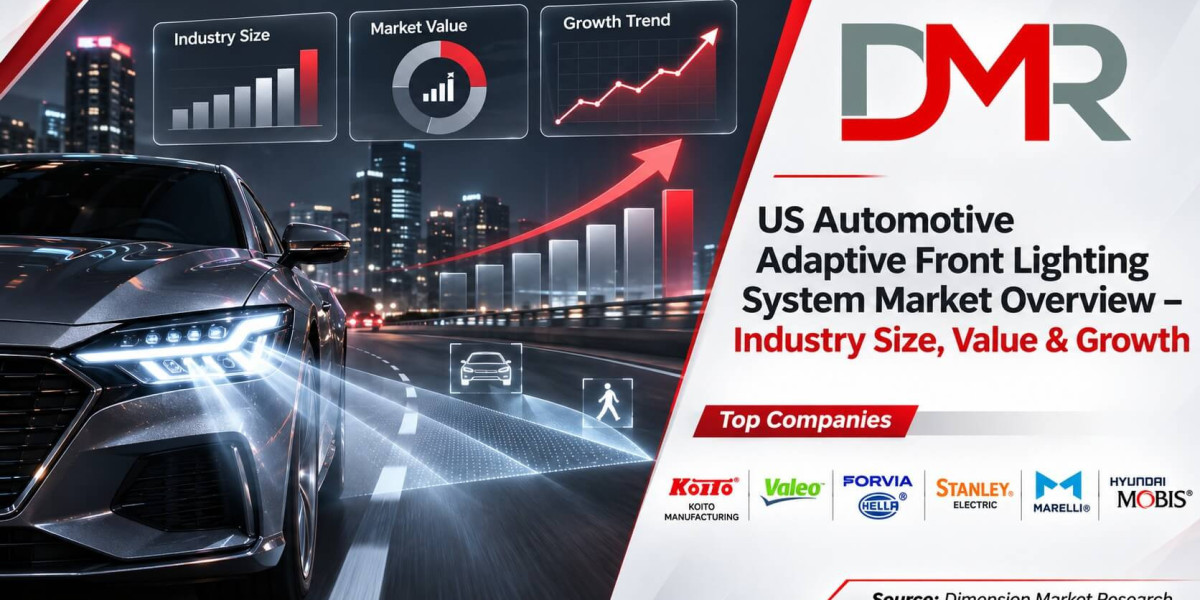

What Is the Current Overview of the US Automotive Adaptive Front Lighting System Market?
The US Automotive Adaptive Front Lighting System Market is gaining momentum as vehicle manufacturers increasingly integrate intelligent lighting technologies to improve nighttime visibility, road safety, and driving comfort. According to Dimension Market Research, the market is projected to reach USD 402.8 million in 2026 and expand to approximately USD 816.7 million by 2035, registering a CAGR of 8.2% during 2026–2035.
This growth reflects rising demand for advanced automotive safety solutions, increasing ADAS integration, and the adoption of LED and matrix lighting technologies. Adaptive front lighting systems automatically modify headlight direction and beam distribution according to vehicle speed, steering angle, road conditions, and surrounding traffic.
Growing consumer interest in premium vehicles, stricter attention to nighttime driving safety, and advancements in camera-based sensing are further supporting market expansion. Automotive manufacturers and lighting suppliers are also investing in intelligent electronic control units, glare-free high beams, and predictive lighting technologies to improve vehicle performance.
Request Sample PDF of This Report: https://dimensionmarketresearch.com/request-sample/us-automotive-adaptive-front-lighting-system-market/
What Is the Expected Value of the US Automotive Adaptive Front Lighting System Market by 2035?
The market is expected to reach USD 816.7 million by 2035, supported by technological advancements and increasing automotive safety requirements.
Market Statistics Snapshot
● The market is valued at USD 402.8 million in 2026.
● The market is forecast to reach USD 816.7 million by 2035.
● The industry is projected to grow at an 8.2% CAGR.
● The forecast period extends from 2026 to 2035.
● The historical assessment covers 2021 to 2025.
● LED technology is expected to hold a 58.7% share in 2026.
● Passenger cars are projected to account for 67.3% in 2026.
● OEM sales channels are estimated to capture 78.5% in 2026.
● Adaptive Driving Beam is expected to secure 44.2% in 2026.
What Are the Latest US Automotive Adaptive Front Lighting System Market Research Findings?
Research findings indicate that electronic control units, LED light sources, and Adaptive Driving Beam technology will remain important contributors to industry development. The ECU component segment is projected to account for approximately 28.4% of revenue in 2026, reflecting its role in real-time beam management. LED technology is expected to dominate with a 58.7% share, while passenger cars will lead vehicle adoption. Additionally, the OEM distribution channel is anticipated to represent 78.5% of the market. Increasing integration of cameras, steering sensors, smart actuators, and ADAS technologies is creating opportunities for advanced lighting manufacturers and automotive technology suppliers.
Why Is the US Automotive Adaptive Front Lighting System Market Growing?
Increasing awareness of nighttime driving risks and demand for improved vehicle safety are supporting market growth. Adaptive lighting systems provide better illumination on curved roads, highways, and challenging weather conditions. Furthermore, the expansion of premium passenger vehicles, electric mobility, and advanced driver assistance systems is increasing demand for intelligent headlights. Regulatory developments supporting Adaptive Driving Beam technology are also encouraging manufacturers to introduce advanced glare-free lighting solutions. Meanwhile, AI-enabled beam control and connected vehicle technologies are creating new opportunities for automotive lighting innovation.
What Are the Key Growth Drivers of the US Automotive Adaptive Front Lighting System Market?
● Increasing demand for improved nighttime driving visibility.
● Growing integration of ADAS and camera-based sensing systems.
● Rising adoption of energy-efficient LED headlights.
● Increasing production of premium and luxury passenger vehicles.
● Regulatory support for Adaptive Driving Beam technology.
● Advancements in smart ECUs and real-time beam control.
● Growing demand for safer commercial vehicle operations.
Which Segment Shows the Highest Growth Potential Within the US Automotive Adaptive Front Lighting System Market?
By Component: Electronic Control Unit (ECU)
The ECU segment is expected to hold the largest component revenue share of approximately 28.4% in 2026. Electronic control units manage lighting operations by processing information from cameras, radar, steering angle sensors, and vehicle speed sensors. Their ability to coordinate real-time beam adjustments makes them essential for intelligent automotive lighting applications. Increasing ADAS integration and demand for reliable vehicle electronics are strengthening the importance of advanced ECUs.
● Real-time adaptive beam management.
● Improved integration with vehicle safety electronics.
● Enhanced lighting control and operational reliability.
Read More About This Market: https://dimensionmarketresearch.com/report/us-automotive-adaptive-front-lighting-system-market/
By Technology: LED Light Sources
LED technology is projected to dominate the market with an estimated 58.7% share in 2026. Its energy efficiency, extended service life, and flexible beam distribution make it suitable for modern adaptive headlights. Matrix LED technology also enables individual light segments to adjust illumination while reducing glare for other road users. Increasing demand for premium vehicles and energy-efficient automotive components is supporting LED adoption.
● Improved energy efficiency and lighting performance.
● Greater flexibility in adaptive beam distribution.
● Increasing integration into premium passenger vehicles.
US Automotive Adaptive Front Lighting System Market Dynamics
What Are the Major Trends Shaping the Market?
AI-enabled performance monitoring, matrix LED adoption, and cloud-based lighting analytics are emerging as important industry trends. Modern adaptive lighting systems increasingly use cameras and sensors to identify surrounding vehicles, road curvature, and environmental conditions. These inputs allow headlights to modify beam distribution dynamically. Digital diagnostics and predictive maintenance are also gaining attention because they help manufacturers identify actuator problems and calibration issues. Additionally, software-based lighting optimization and over-the-air updates are creating opportunities to improve system functionality throughout the vehicle lifecycle.
What Are the Future Growth Opportunities in the Market?
AI-powered predictive lighting represents a promising opportunity for automotive technology providers. These solutions can analyze road conditions, identify approaching vehicles, and optimize illumination before drivers encounter changing road environments. Cloud-connected diagnostics and remote calibration may also improve fleet maintenance efficiency. Furthermore, increasing electric vehicle production and demand for advanced vehicle electronics are expected to encourage the development of compact, energy-efficient lighting modules. Strategic partnerships between automotive OEMs, semiconductor companies, and lighting manufacturers could accelerate product innovation and commercial adoption.
What Challenges Are Affecting the Market?
High component costs and complex system calibration remain important market challenges. Matrix LED modules, smart actuators, advanced sensors, and electronic control units increase manufacturing and integration expenses. These costs can limit adoption in budget-sensitive vehicle categories. Additionally, adaptive lighting systems require accurate sensor alignment and specialized diagnostic equipment, creating difficulties for independent repair facilities. Moisture protection, thermal management, software compatibility, and regulatory compliance also influence product development. A shortage of trained technicians capable of maintaining sophisticated automotive lighting systems may further affect aftermarket expansion.
Who Are the Leading Companies in the US Automotive Adaptive Front Lighting System Market?
The competitive landscape includes established automotive lighting manufacturers, electronic component suppliers, and technology providers. Companies compete through product innovation, advanced beam control, manufacturing capabilities, and strategic OEM partnerships.
● Koito Manufacturing Co., Ltd.
● Forvia SE (HELLA GmbH & Co. KGaA)
● Valeo SE
● Marelli Holdings Co., Ltd.
● Stanley Electric Co., Ltd.
● ZKW Group GmbH
● Varroc Engineering Limited
● SL Corporation
● Ichikoh Industries, Ltd.
● Robert Bosch GmbH
● Continental AG
● Denso Corporation
● Texas Instruments Incorporated
● ams-OSRAM AG
● Lumileds Holding B.V.
● Aptiv PLC
● Magna International Inc.
● Hyundai Mobis Co., Ltd.
● Johnson Electric Holdings Limited
● Koninklijke Philips N.V.
Recent Industry Developments
● In March 2026, Koito Manufacturing expanded production capacity for advanced adaptive lighting modules to address increasing demand from global automotive OEMs, particularly in next-generation and electric vehicles.
● In April 2025, Valeo announced a strategic partnership with Appotronics to develop next-generation front lighting systems incorporating laser projection technology and enhanced Adaptive Driving Beam functionality.
Get 10% instant discount on report purchase
Related Reports:
● Japan Automotive Adaptive Front Lighting System Market
● Automotive Torque Converter Market
● Automotive Alternator Starter Motor Market
● Automotive Fleet Leasing Market
(FAQs)
1. What is the projected size of the US Automotive Adaptive Front Lighting System Market by 2035?
2. What is the expected CAGR of the US Automotive Adaptive Front Lighting System Market?
3. Which factors are driving demand for adaptive front lighting systems in the United States?
4. Which technology segment is expected to dominate the US adaptive front lighting market?
5. Why is LED technology gaining popularity in automotive adaptive lighting systems?
6. What role does ADAS integration play in the US automotive adaptive lighting industry?
7. Which companies are the leading manufacturers of adaptive front lighting systems in the US?
8. How is artificial intelligence transforming adaptive headlight technology and beam control?
9. What challenges are limiting the adoption of adaptive front lighting systems in the US?
10. What future opportunities will shape the US Automotive Adaptive Front Lighting System Market through 2035?
About Us
Dimension Market Research (DMR) is a global market intelligence and consulting firm delivering data-driven insights that help organizations make informed strategic decisions. With expertise across 12+ industries and global markets, DMR provides syndicated reports, custom research, competitive analysis, white space analysis, and business strategy consulting.
Our research solutions combine analytical rigor, industry expertise, and forward-looking intelligence to identify opportunities, reduce risks, and support sustainable growth. Trusted by clients across diverse sectors, DMR is committed to delivering accurate, actionable insights that enable businesses to navigate evolving market landscapes with confidence.
Contact Us



