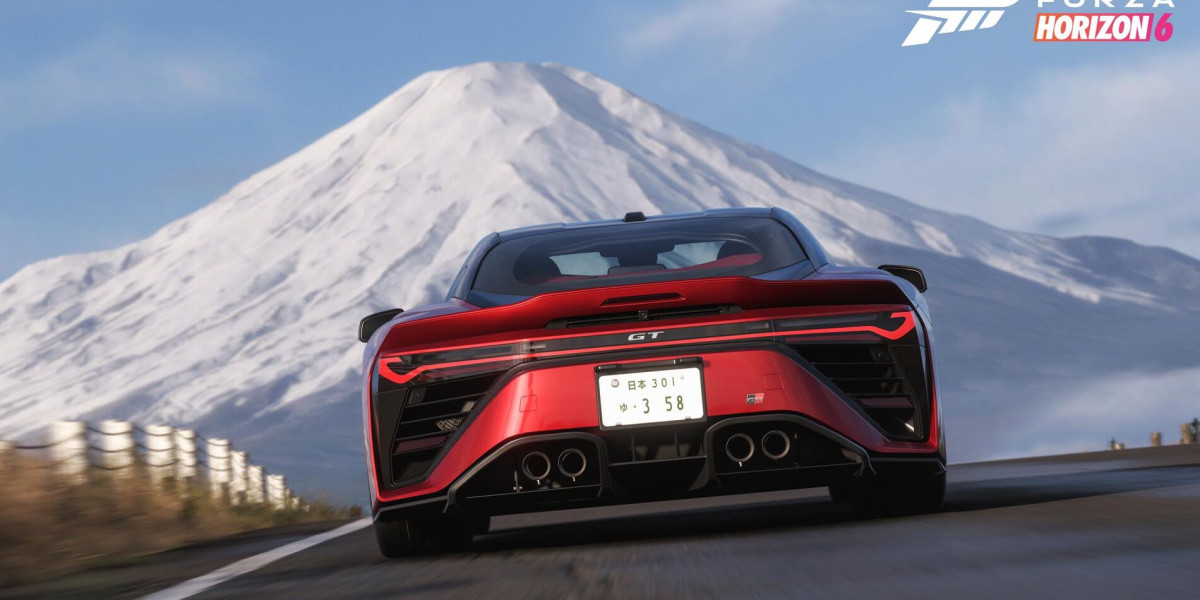

Forza Horizon 6 becomes much more enjoyable when the garage is treated as a playground for different driving ideas rather than a simple list of cars. A classic Japanese coupe can become a tight mountain racer, a compact sports car can be transformed into a cornering specialist, and a powerful machine can be reserved for long highway runs. With the current Horizon Mascot Party series rotating through new challenges, having enough Forza Horizon 6 Credits can make it easier to prepare several cars for different events instead of relying on one build for everything.
The current Winter season of Series 4 runs from August 27 to September 3, 2026, and the Festival Playlist is once again mixing traditional championships with smaller challenges, Treasure Hunt activities, Photo Challenges, PR Stunts, and other events. The featured Winter rewards include the 1974 Toyota Celica GT at 20 Playlist Points and the 1989 Toyota MR2 SC at 40 Points. Both cars are especially interesting for players who enjoy older Japanese machinery and lower-class racing.
The 1974 Toyota Celica GT starts at D-Class 287 PI, making it one of the slower reward cars in the current season. That might sound like a disadvantage, but lower performance can actually create a more technical driving experience. With limited power, there is greater emphasis on maintaining momentum. Braking too late becomes expensive because there is not enough acceleration to recover lost speed, while a clean racing line can make the car surprisingly effective on narrow roads.
The 1989 Toyota MR2 SC offers another type of challenge. Its compact size and rear-wheel-drive layout make it particularly interesting on tighter routes. Drivers who normally use heavier front-engine vehicles may need some time to adjust their cornering approach. Smooth steering and progressive throttle control can keep the car settled, especially when exiting slower turns.
Winter conditions add another layer to both cars. Snow-covered roads can punish aggressive inputs, especially when a driver tries to accelerate too early. Instead of treating every corner like a dry-weather race, it can be better to brake slightly earlier, rotate the car smoothly, and gradually increase throttle once the tires have enough grip. This approach is particularly useful for rear-wheel-drive builds.
The current Ohtani Region Treasure Hunt is also part of the Winter Playlist. The challenge uses a photo clue to guide players toward a treasure location in the Ohtani Region, northwest of Tokyo City and east of the Shimanoyama area. It offers a welcome change from conventional racing because the objective involves exploration and observation rather than simply finishing ahead of opponents.
Treasure Hunts are also a useful reminder that knowing the map can be just as valuable as knowing a car. Fast travel is convenient, but driving through different regions reveals shortcuts, elevation changes, road surfaces, and corners that may become useful during future races. A player who learns the surrounding roads can often approach custom events with much more confidence.
The Festival Playlist is also easier to manage when activities are divided into categories. Quick objectives can be completed first, followed by championships and more specialized events. Checking the requirements before selecting a car prevents unnecessary tuning. If an event requires a particular class or vehicle type, building around that requirement is generally more efficient than modifying a favorite car without checking the rules.
Tuning itself can become a separate form of gameplay. A common mistake is to focus too heavily on horsepower. More power is useful on long straights, but it cannot compensate for poor braking or unstable cornering. For technical routes, better tires, balanced suspension, and predictable braking can produce a larger improvement than another major engine upgrade.
The same principle becomes obvious during Time Attack. Horizon Mascot Party introduced a temporary Time Attack Circuit, giving players a dedicated place to chase faster lap times. Without opponents constantly changing the racing line, every mistake becomes easier to identify. A driver can determine whether time is being lost during braking, corner entry, the apex, or acceleration out of the corner.
Corner exits deserve particular attention. A slightly slower entry can sometimes produce a significantly faster lap when it allows earlier acceleration. If a long straight follows the corner, the additional speed continues to build until the next braking zone. This is why a clean exit is often more important than a dramatic late-braking maneuver.
Mountain driving provides an excellent environment for practicing this technique. Japanese mountain roads frequently combine tight corners with elevation changes, leaving little room for excessive steering corrections. A stable car that responds predictably to throttle changes can be more useful than a high-powered build that constantly threatens to lose traction.
Drifting creates a completely different goal. Instead of eliminating tire slip, the driver needs to control it. A good drift setup should provide enough power to maintain the slide without making every transition unpredictable. Steering angle and throttle should work together, and small adjustments are usually more effective than constantly applying maximum input.
The Horizon Mascot Party update also expands the creative side of the game with themed EventLab props, including mascot flags, billboards, cutouts, barriers, and other decorative objects. These additions create more possibilities for custom routes and themed races. A garage with several specialized cars makes those custom events even more interesting because different vehicles can be assigned to completely different challenges.
Collecting cars therefore becomes more meaningful when each vehicle has a purpose. One build might be reserved for seasonal championships, another for Time Attack, another for drifting, and another for relaxed mountain exploration. This approach also prevents the garage from becoming a collection of cars that look impressive but rarely leave the showroom.
For players who want additional marketplace support while expanding that variety, U4GM can be a practical option. Competitive pricing, convenient access, and an emphasis on secure service can reduce some preparation time without replacing the actual gameplay. The important part remains the driving itself, from learning a new car's handling to finding a faster route through a difficult corner.
A broader garage can ultimately make every new Festival Playlist feel more interesting because different objectives create different reasons to bring out different cars. Players who want to begin with more developed options and explore seasonal racing, Time Attack, mountain driving, drifting, and custom events from a wider starting point can consider buy FH6 Modded Accounts as another route into the expanding world of Forza Horizon 6.