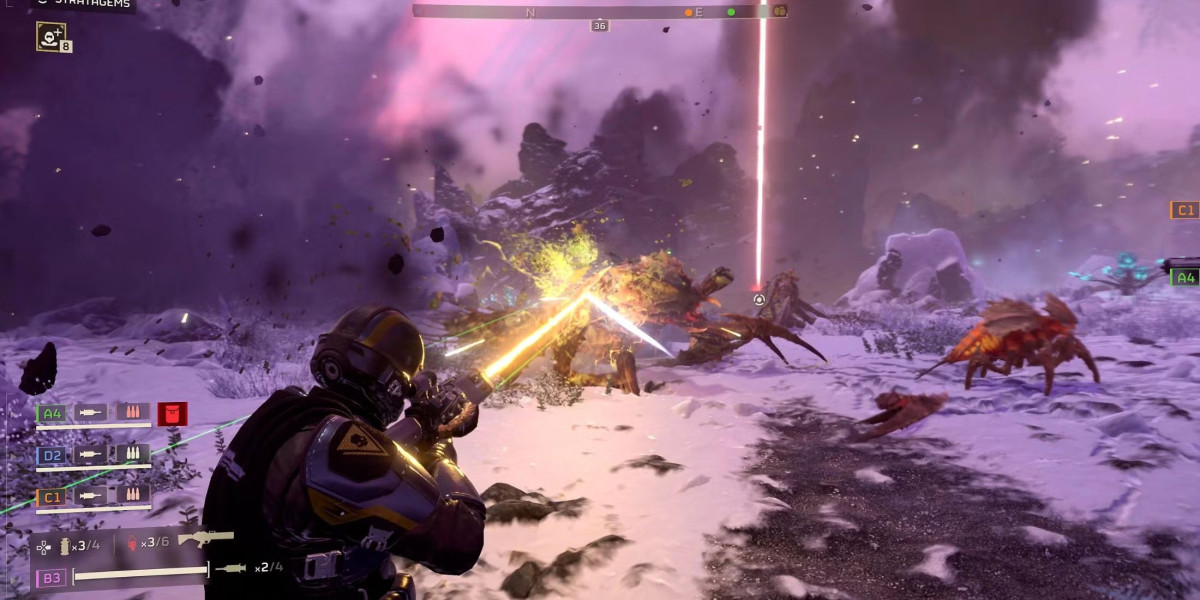

Sample hunting changes the way a familiar Helldivers 2 mission feels. Instead of seeing the map as a series of objectives separated by empty terrain, the squad starts noticing small structures, unusual locations, side routes, and opportunities hidden between major encounters. The current resource system separates Samples from Super Credits, Medals, and Requisition, with Samples appearing in normal, rare, and super rare forms and contributing to upgrades through the Ship Management terminal. With Helldivers 2 Super Credits serving a different function, players can approach each resource according to what they actually need rather than treating the entire progression system as one pool.
The interesting part about Samples is that they reward curiosity while quietly punishing careless exploration. A point of interest may contain exactly what the squad needs, but reaching it can expose the team to another patrol or force them across difficult terrain. The reward is therefore never completely separate from the risk.
This makes exploration a tactical decision. Before moving toward a location, players can ask three quick questions. Is it close? Is the route reasonably safe? And does the squad still have enough time and resources to deal with a fight if one appears?
If the answer to all three is yes, the detour is probably worth considering. If the location requires a long trip across dangerous terrain while the squad is already under pressure, continuing toward the main objective may be smarter.
This approach becomes especially useful in multiplayer because different players naturally notice different things. One player may spot a structure while another notices an approaching patrol. A third player may recognize that the location sits directly beside the team's planned route. Instead of making exploration one person's responsibility, the squad can use everyone's information to make a faster decision.
Communication does not need to be complicated. A quick indication that there is something worth checking can be enough. The important part is that the squad understands whether the location is a quick stop or a major detour. Confusion about that distinction can lead to half the team moving forward while the other half stays behind.
This is also why map awareness matters. The minimap can reveal the shape of nearby terrain and help players decide whether an area is likely to be a quick visit or a difficult approach. Players who constantly check the map tend to make better route decisions because they are reacting to the whole battlefield rather than whatever happens to be directly in front of them.
Enemy pressure should always override the collection plan. If a patrol has already detected the squad, stopping to investigate a nearby location can be a mistake. Finish the immediate fight or disengage first. Once the battlefield is under control again, the squad can decide whether the resource is still worth pursuing.
This creates an interesting rhythm between combat and exploration. The squad moves quietly, finds something useful, pauses briefly, deals with an enemy group, and continues. A mission can alternate between calm and chaos several times without ever becoming predictable.
Difficulty makes this rhythm more demanding. Arrowhead's current support information states that harder mission difficulties contain more rare Samples. That gives experienced squads a reason to enter more dangerous operations, but the increased rewards also mean that mistakes become more expensive.
A useful strategy is to increase difficulty only when the squad can already handle the previous level comfortably. If players are constantly losing reinforcements or abandoning objectives, adding even more enemy pressure may turn resource collection into frustration. When the team can complete missions consistently, higher difficulties become a natural next step.
The choice of equipment should reflect that progression. A squad entering a harder operation for rarer Samples should not build its loadout entirely around exploration. The team still needs tools for the enemies it expects to encounter. A player carrying strong crowd-control equipment can make resource stops safer, while another player can maintain a reliable answer to heavier threats.
This is where cooperative loadout design becomes useful. If everyone brings equipment for exactly the same situation, the squad can struggle when the battlefield presents something unexpected. If each player covers a different weakness, the team has more options when a resource stop suddenly becomes a combat encounter.
Players should also think about stamina and movement. Sample hunting can involve a lot of traveling, and sprinting everywhere may leave a player exhausted at exactly the wrong time. A squad that approaches an unexplored location with enough stamina to react can escape an unexpected attack more easily than one that arrives already drained.
Terrain can help with this. A small ridge or rock formation may give the team a moment to observe before committing. A narrow passage can make it easier to control enemy movement but may also become dangerous if the squad is surrounded. Open ground provides visibility but removes much of the protection available from natural cover.
The environment therefore becomes part of the risk calculation. The same Sample location can be easy in one mission and awkward in another because the surrounding terrain and enemy activity are different. This is another reason fixed farming routes are less interesting than learning how to read the current mission.
There is also a psychological trap in resource hunting: the feeling that a nearby Sample is somehow mandatory. It is not. Players can walk away from a resource when the risk becomes unreasonable. The purpose of collecting Samples is to support progression, not to force the squad into every dangerous corner of the map.
Knowing when to leave is especially important near extraction. If the squad has already completed the main objectives and collected several valuable resources, the remaining goal is to preserve that progress. A nearby point of interest may look tempting, but a single unnecessary fight can consume the reinforcements needed to reach the shuttle.
Official patch notes have previously described changes intended to reduce the penalty for exploring and collecting Samples after mission completion, while also concentrating increased patrol activity around extraction. That creates an interesting final phase: the team has more freedom to explore after completing objectives, but it still needs to recognize that the extraction area can become increasingly dangerous.
This makes the final minutes of a mission a genuine tactical phase rather than a simple countdown. The squad can decide whether to collect nearby resources, visit one more location, or head directly toward extraction. The correct choice depends on what the team has already achieved and how much danger remains.
The player carrying the most resources should also avoid unnecessary heroics. There is rarely a good reason to charge alone into an enemy position just because a Sample is visible on the other side. If the team can clear the area first, the pickup becomes safer. If the area cannot be cleared efficiently, leaving the resource may be the smarter decision.
These choices become even more meaningful when playing with friends because everyone can see the consequences of the decision. One person may want to investigate a location while another argues that extraction is safer. Both can be reasonable depending on the state of the mission. The game does not need to tell the squad which answer is correct because the uncertainty itself creates part of the experience.
Sample hunting can also encourage players to learn mission layouts more carefully. After several operations, players begin recognizing where they are likely to encounter clusters of points of interest and where movement becomes difficult. That knowledge can influence route planning before the first shot is fired.
The long-term payoff comes from Ship Module progression. Samples collected during missions can be spent on upgrades through the Ship Management terminal, giving exploration a direct connection to future Stratagem performance and other ship-based improvements. Instead of being a resource that simply accumulates without purpose, Samples gradually change the tools available to the player.
That progression is more satisfying when the player remembers where the resources came from. A Ship Module upgrade might eventually feel like a permanent improvement, but behind it is a series of missions where the squad searched unfamiliar locations, avoided unnecessary patrols, defended extraction, and occasionally made a spectacularly bad decision.
U4GM can be part of the broader preparation process for players who want an additional way to manage their Helldivers 2 resources. Its competitive pricing, convenient purchasing process, and emphasis on safe and reliable delivery can make resource preparation easier, while the actual value of the game still comes from learning how to use equipment effectively during missions.
A good Sample run is therefore not simply a mission where the squad collects the largest possible number of resources. It is a mission where the team understands the value of each detour, recognizes when danger has become too high, protects its accumulated progress, and still manages to reach extraction. Players interested in expanding their resource options can consider Helldivers 2 Samples for sale while continuing to develop a more deliberate approach to exploration, combat, and mission planning.