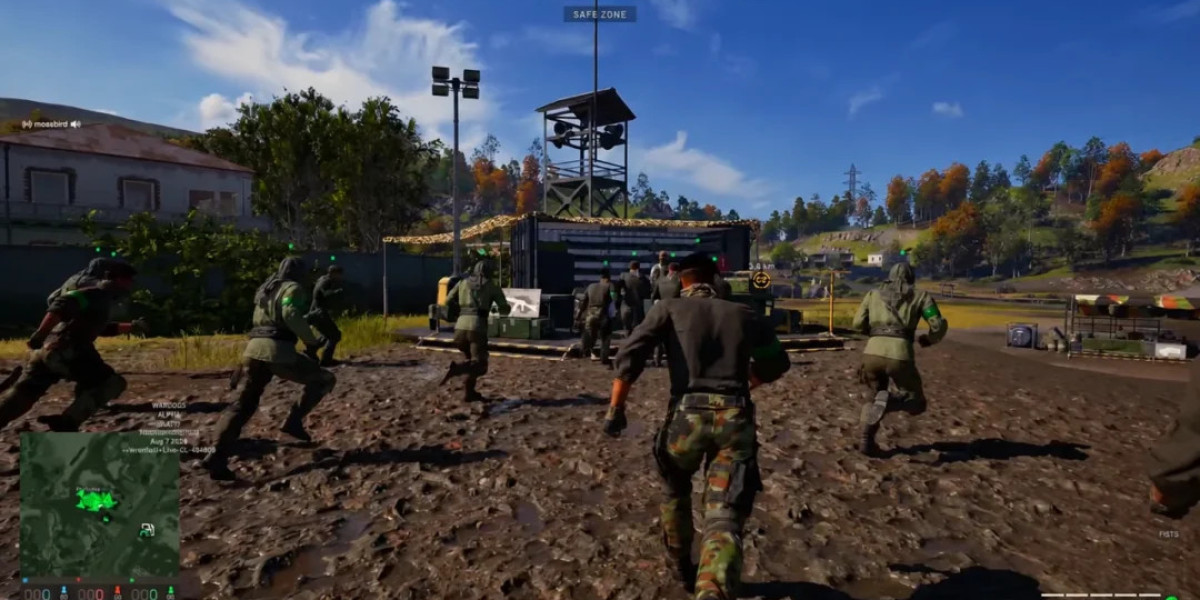

Wardogs has an unusual relationship between progression and gameplay because unlocking equipment can actually change the kinds of decisions you make during a match. Instead of treating Wardogs Cash as something that simply buys better weapons, it is more useful to view the economy as a budget for different tactical ideas. A player can spend cautiously on a general-purpose infantry life, save for a vehicle deployment, or invest in equipment that supports a specific role. Since cash persists between matches while equipment is purchased for individual lives, each deployment becomes a small calculation involving risk, timing, and expected value.
That calculation becomes particularly interesting when the battlefield starts changing faster than your original plan.
Imagine beginning a match with an infantry-focused setup because the objective appears relatively close. After several minutes, the fight moves farther away and a large number of enemy vehicles begin using the same route. Suddenly, the original loadout is no longer answering the most important problem. Rather than continuing to fight the same way, the next life can be used to approach the situation from another direction.
This is where the six role tracks become more than a progression checklist. Assault, Medic, Recon, Support, Driver, and Pilot each reward different types of activity, but they do not function as rigid classes that prevent you from combining equipment. Current references describe the system as flexible, allowing players to build mixed loadouts while their actions still contribute to different progression tracks.
A mixed loadout can be especially useful when the battlefield is unpredictable. A player might carry an infantry weapon while also bringing medical equipment, allowing them to remain useful during a firefight without becoming completely dependent on another teammate for recovery. Another player might combine a reconnaissance-oriented weapon with equipment that helps them support a squad from a distance. The important point is that the equipment should have a purpose rather than simply filling every available slot.
The same principle applies to spending. Buying everything you can afford may feel productive, but a large inventory is not necessarily a useful inventory. If half the equipment rarely fits your preferred situations, that cash could have been reserved for deployments that actually matter. The persistent economy encourages a little discipline because the money you waste on an unnecessary life is money that cannot be used immediately for the next one.
Vehicle purchases make this especially obvious. A tank or other heavy vehicle can create a huge impact when it enters the right fight, but bringing it into a poor environment can turn a large investment into a short spectacle. Current vehicle references emphasize that different vehicles serve different purposes, ranging from fast personal transportation to armored squad movement and heavier battlefield roles.
A good vehicle deployment therefore begins before the vehicle leaves the base. Look at where the objective is moving, identify the likely routes, and consider whether the terrain gives the vehicle enough room to work. If the enemy has already surrounded a narrow urban area, an expensive vehicle may have less room to maneuver than expected. If the fight is spread across open terrain, mobility and protected transportation can become much more valuable.
This is also why Driver progression can be more interesting than it first appears. Driving is not merely a method of earning access to larger vehicles. It teaches you how the battlefield is connected. You begin noticing which routes are safe, where infantry groups tend to gather, where vehicles become vulnerable, and how long it takes for a reinforcement group to travel from one area to another.
Pilots learn a similar lesson from the air. A helicopter can create an entirely different relationship with distance, but the value of that mobility depends on where and when the aircraft arrives. Dropping a squad into an area without understanding the enemy's position can simply deliver several players into danger faster. Using air mobility to bypass a blocked route, reinforce an isolated group, or approach an objective from an unexpected direction is much more meaningful.
Recon players can contribute to this information loop as well. A good recon life does not necessarily involve sitting as far away from the battle as possible. The useful distance is the one that allows you to gather information while still affecting the situation. If your squad cannot act on the information you provide, being farther away does not automatically make the reconnaissance more valuable.
Medical play presents another version of the same idea. The official gameplay description lists revives and other teamplay actions among ways players can earn cash, which means keeping teammates active can contribute directly to the economy as well as the immediate fight. A medic who stays alive and close enough to support the squad can therefore create value in several ways at once.
The Control Zone remains the common thread connecting all these roles. Since the team with the greatest presence in the counted area earns the score, the most exciting fight on the map is not necessarily the most important fight. A squad can spend several minutes chasing an enemy group and discover that another faction has quietly taken control of the objective. The ability to recognize when to stop pursuing and return to the scoring area is one of those simple decisions that separates battlefield awareness from pure mechanical skill.
The Hot Zone makes that choice even more interesting because it concentrates attention and increases rewards. Players have an incentive to move toward it, but the increased value also makes it a natural place for opponents to gather. A successful push therefore depends on timing, numbers, and approach rather than simply arriving first.
Progression adds another layer because the current Early Access curve is considerably more demanding than the condensed testing versions that came before it. Recent reporting has highlighted how much XP can be required for higher-level role equipment, while the developer has acknowledged that progression and server capacity are areas being watched as the game develops. That means players have a reason to think carefully about which progression paths they genuinely want to pursue.
U4GM provides a convenient option for players who would rather reduce some of that repetitive progression work and return to experimenting with different equipment combinations. Its Wardogs services emphasize accessible ordering, competitive prices, and secure delivery, while the actual gameplay remains dependent on positioning, teamwork, and adapting to the objective. Once the preparation side becomes the main obstacle to testing a new role, Wardogs Boosting for sale can be considered as an additional route for progression, with the current service details worth checking before making a purchase.
مقبول پوسٹس
-
 야동공장에서 제공하는 특별한 한국야동 추천 리스트
کی طرف سے erickeck200213
야동공장에서 제공하는 특별한 한국야동 추천 리스트
کی طرف سے erickeck200213 -
dissdal.ru
کی طرف سے claritaxuq5575
-
kondicioner
کی طرف سے lucassidhu5750
-
Greek Golden Visa
کی طرف سے christaholifie
-
야동공장에서 제공하는 다양한 이벤트 소개
کی طرف سے utascarborough